June 9, 2026
/
The Mexican restaurant category is one of the fastest-growing segments in quick-service dining. According to the 2026 Technomic Top 500 Chain Restaurant Report, the limited-service Mexican category generated $35.1 billion in U.S. sales in 2025, growing 4.7% year-over-year and outpacing the pizza segment for the second consecutive year.[i]
Within the Mexican fast casual segment, franchise buyers today have more options than ever. Established brands like Qdoba and Moe’s Southwest Grill operate hundreds of locations. Del Taco has grown past 600 restaurants nationwide. And a new generation of fast-casual concepts is pushing into markets with fresh energy and differentiated menus.
Somewhere between the category’s heavyweights and its newest entrants sits Bubbakoo’s Burritos, a bold brand that has quietly built a compelling case for serious franchise investors. What follows compares Bubbakoo’s against the field on the factors that matter most: investment requirements, unit economics, system size, brand positioning, territory availability, and growth potential.
Investment Requirements Vary Significantly Across the Category
For most franchise buyers, the investment range is the first filter. Here is where the numbers stand.
According to its Franchise Disclosure Document, Bubbakoo’s Burritos carries an estimated investment range of $356,000 to $757,000 for a new restaurant. By comparison, Qdoba’s FDD reports a range of approximately $548,000 to $1.29 million. Moe’s Southwest Grill comes in higher still, at roughly $718,000 to $1.99 million. Information on Del Taco’s website indicates an estimated range of approximately $1.5 million to more than $3.3 million, depending on format and market.
Bubbakoo’s also offers a conversion option for qualified candidates who identify an existing restaurant space. By building out a previously operated location rather than starting from scratch, franchisees can reduce construction costs significantly. That path carries an estimated investment range of $233,000 to $507,000, meaningfully lower than a ground-up build.
For investors who want exposure to a growing Mexican QSR brand without committing to the capital requirements of more mature systems, Bubbakoo’s offers a considerably lower entry point.
What the Revenue Numbers Actually Mean
Serious franchise prospects always ask about average unit volume, and they should. AUV tells you how much revenue a typical location generates. It is one of the most important data points in the evaluation process.
Bubbakoo’s 2026 FDD reports a system average of $938,646. That number is lower than some of the larger brands in this comparison, and it is worth being direct about that.
Financial performance information is based on data reported in Item 19 of the 2026 Franchise Disclosure Document (FDD). Individual results will vary. Prospective franchisees should review the FDD carefully and conduct their own due diligence before making any investment decision.
But here is the question that actually matters: what does that revenue mean relative to what you put in?
A brand posting $1.2 million in AUV sounds impressive until you factor in that you spent $1.5 million or more to get there. At that ratio, you are spending more than a dollar to generate a dollar. The math gets harder, and the margin for error shrinks.
Bubbakoo’s lower investment range changes that equation. At an average new-store cost of approximately $550,000, the brand achieves close to a 2:1 sales-to-investment ratio. When your startup cost is meaningfully lower, a $938K AUV carries further. Additionally, Bubbakoo’s combined royalty and marketing fees of 8% also compare favorably to several competitors in this analysis, where combined fees range as high as 9.5%. With roughly half of all orders flowing through digital channels, the brand benefits from the operational efficiencies that come with a high-volume, lower-friction ordering model.
Beyond the system average, investors often evaluate the range of performance across a franchise system. According to the 2026 FDD, top-performing Bubbakoo’s locations reported gross sales of approximately $1.9 million, well above the system average. While individual results vary, the spread between average and top-performing locations highlights the potential impact of factors such as market selection, local execution, and operational management.
Bubbakoo’s Occupies a Productive Middle Ground in System Size
System size tells a story about proof of concept, available territories, and the stage of growth a brand has reached.
Qdoba operates approximately 827 locations. Moe’s Southwest Grill has roughly 568 units. Del Taco exceeds 600 restaurants. These are proven systems with long operating histories.
Bubbakoo’s currently operates approximately 145 locations, with more than 200 open or under development. That number is large enough to validate the operating model, demonstrate unit-level economics, and support a real infrastructure. It is also small enough that prime development territories remain available in many markets. The larger competitors, with systems two to six times the size of Bubbakoo’s, have absorbed much of the available territory in established markets, narrowing the development runway for new investors.
A Brand Built for How People Eat Today
Not all restaurant concepts age equally. Bubbakoo’s was built around a customer experience that reflects current dining behavior, not the conventions of a prior decade.
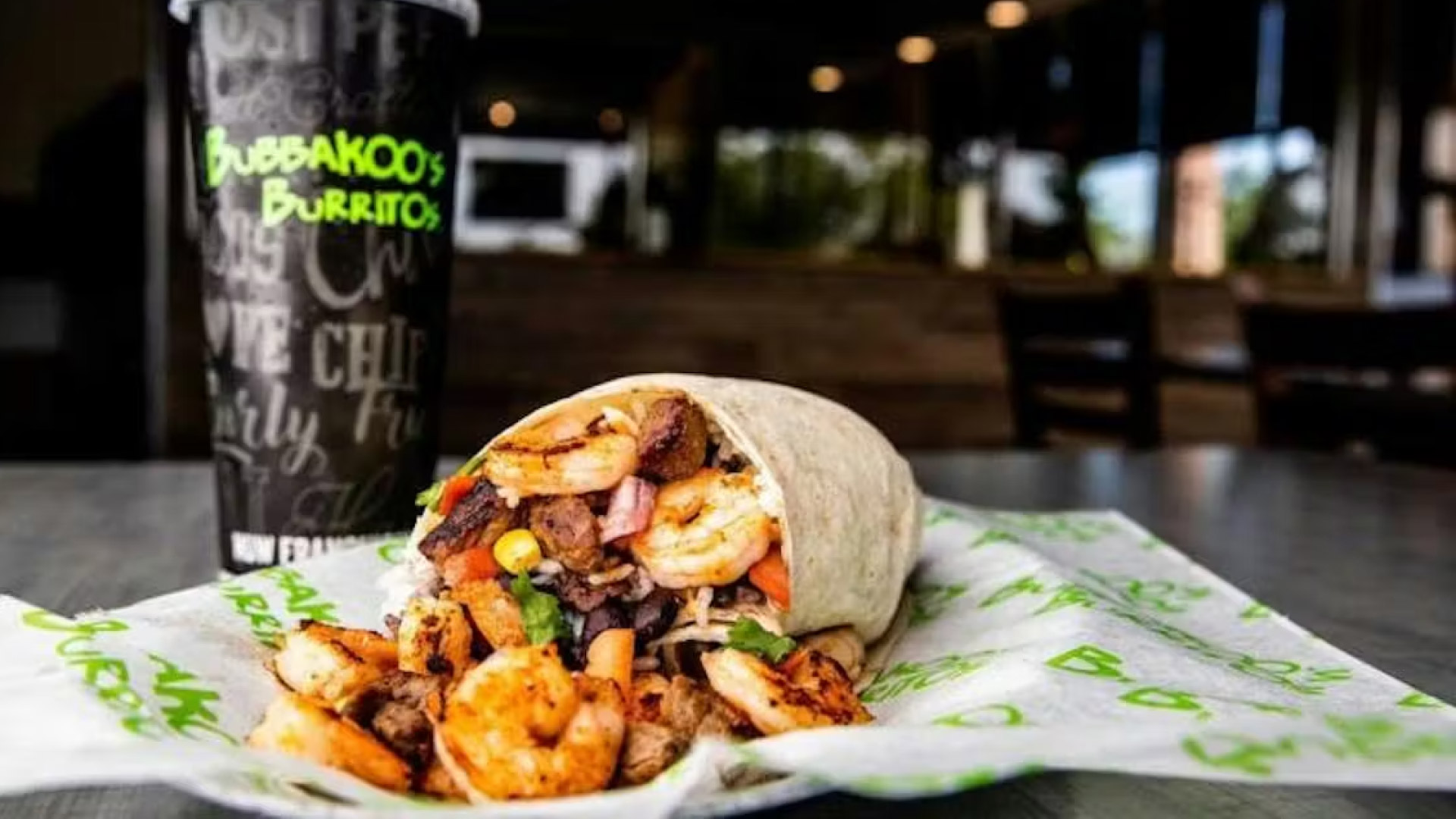
The brand leads with a Mexican fusion menu that blends traditional Mexican-inspired staples with globally influenced flavors: General Tso’s chicken, hibachi steak, Nashville Hot chicken. The Chiwawa, a fried rice ball used as a base, and the Burritodilla, a burrito-quesadilla hybrid, are the kinds of menu items that generate genuine customer enthusiasm. These are not safe, committee-designed additions. They reflect a brand with a real culinary point of view.
That identity carries through the store experience. Customers consistently describe Bubbakoo’s locations as clean, modern, and energetic, with a youthful atmosphere that drives repeat visits. The brand traces its roots to the casual, community-driven atmosphere of the New Jersey shore, giving it a personality that purely corporate concepts often struggle to replicate.
The operational model reflects where consumer behavior has moved. Fifty percent of orders come through digital channels. The average customer ticket is $31. A 4.8-star mobile app drives loyalty and repeat traffic. These are not aspirational targets. They are current performance metrics.
And the customer sticks around. Fifty-six percent of repeat customers return within 90 days, generating an average lifetime spend of $263 per guest.
Territory Availability Shapes Long-Term Opportunity
Bubbakoo’s development strategy is built around multi-unit franchisees who plan to open three or more locations. Single-unit opportunities may be considered for the right candidate and market, but portfolio-minded operators are the brand’s primary focus. That distinction shapes how the brand allocates territories, structures agreements, and supports new franchisees through the opening process.
In mature systems, desirable markets are frequently already awarded. Franchisees entering those systems often do so through resales rather than new development agreements.
Bubbakoo’s currently offers protected territories and continues expanding across the United States. The brand has reported a 65% unit growth CAGR from 2019 to 2025. In June 2025, St. Louis-based private equity firm Thompson Street Capital Partners acquired Bubbakoo’s Burritos, citing plans to invest in technology, brand development, infrastructure, and franchisee support systems.[ii] For multi-unit operators evaluating a growing brand, that kind of institutional backing is a meaningful signal.
For candidates focused on multi-unit growth, the brand currently offers development opportunities in markets that may become more limited as the system expands.
Where Bubbakoo’s Stands
Evaluating a franchise investment requires more than comparing menus or chasing the highest AUV number. The meaningful questions involve capital requirements, unit economics relative to investment, brand momentum, customer loyalty, territory availability, and the stage of growth the system has reached.
Bubbakoo’s Burritos enters that comparison with a lower investment threshold than most of its established competitors, a differentiated brand with demonstrable customer enthusiasm, unit economics that hold up under scrutiny, and a growth trajectory backed by institutional capital. The system is large enough to be credible and small enough to offer real opportunity.
To learn more about Bubbakoo’s Burritos, visit the franchise website and download the Franchise Information Guide.
[i] Nation’s Restaurant News, “2026 Technomic Top 500 Chain Restaurant Report,” April 22, 2026
[ii] Restaurant Business, “Bubbakoo’s acquired by private-equity firm Thompson Street Capital Partners”